
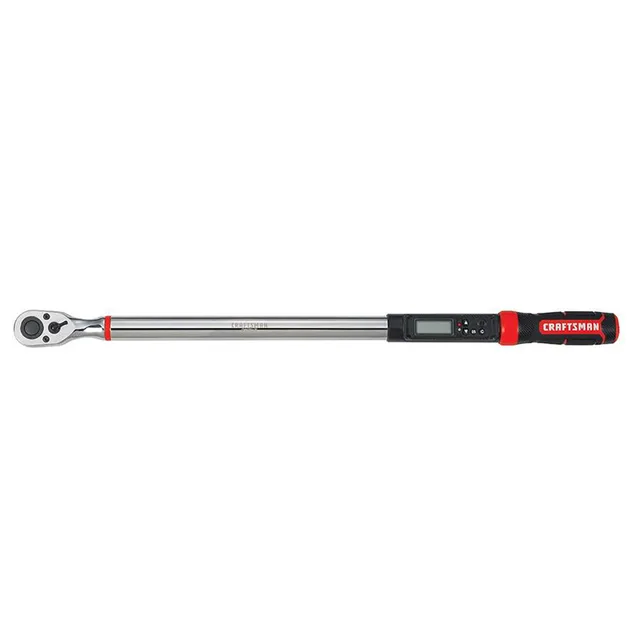
Craftsman 1/2 in. Digital Torque Wrench Review
We may earn a commission from some links on this page.
The Craftsman 1/2 in. Digital Torque Wrench (model CMMT99436) is a digital torque wrench for jobs where a fastener has to be pulled down to a set figure rather than guessed at. Craftsman describes it as a click-style wrench with an LED backlit screen, a ratcheting head and a clear storage case, built for brake work, engine work, motorcycles, four-wheelers and small engine repairs. This review walks through what the maker publishes about the tool so you can judge whether it suits the work you have in front of you.
Key Takeaways
- A 1/2-inch drive digital torque wrench with a ratcheting head.
- The LED backlit screen is designed to stay readable in low light.
- Torque values convert between ft/lb, in/lb and Nm at the touch of a button.
- Click-style confirmation tells you when the set torque is reached.
- Chrome vanadium steel body, cushion grip handle and a clear storage case.
The Digital Readout and Unit Switching
The centre of this tool is its display. Craftsman fits an LED backlit screen so the numbers stay legible when you are working under a wheel arch, inside a dark engine bay or in a garage with poor lighting. The backlight matters more than it sounds: reading a mechanical scale by torchlight is easy to get wrong.
Unit switching is handled by a button rather than a scale change. Craftsman states that the wrench converts torque from ft/lb to in/lb to Nm at the touch of a button, which covers the three sets of figures you meet in service manuals, on fastener packs and on aftermarket parts.
That matters most on mixed jobs. A wheel nut is usually quoted in ft/lb, small engine and motorcycle fasteners often come in in/lb, and imported parts frequently list Nm. A wrench that moves between all three means you do not have to convert by hand and then hope the arithmetic was right. If you want a second wrench for the smaller sizes, the Harfington 3/8-inch digital torque wrench is the smaller-drive option in the same digital format.
Click Confirmation and the Ratchet
Craftsman calls this a click-style wrench, and the click is the part that does the work at the moment of tightening. You set the figure on the tool, pull until the wrench signals, and stop. That signal is what separates a torque wrench from an ordinary breaker bar: without it you are judging by feel.
The head ratchets, which matters when you are working in a tight space and cannot swing the handle through a full arc. A ratcheting head lets you reset the handle and keep pulling in the same direction until the click arrives, instead of repositioning the socket each time.
Craftsman lists the wrench for small engine repairs, four-wheelers, motorcycles, brakes and engines. Those are the jobs where the click does the most good: caliper bolts, brake line fittings, valve covers, spark plugs on small engines and the like. For heavy suspension work and axle nuts you may want the higher range of a dedicated 1/2-inch mechanical wrench as well.
Handle, Case and Build
The body is chrome vanadium steel, a standard alloy for hand tools because it holds its shape under load. Craftsman finishes the tool in black and red and fits a cushion grip handle with ergonomic styling for a sure hold while you pull.
A clear storage case comes with it. That is not a small thing on a torque wrench: the tool is a measuring instrument, and a case keeps it out of the bottom of a toolbox where it would take knocks between jobs. The clear lid also means you can see which wrench you are picking up without opening it.
Craftsman states that the wrench meets or exceeds ASME specifications. If you already own a 1/2-inch socket set, the DEWALT 1/2-inch drive socket set is the natural pairing, since it matches the drive size of this wrench.
Detailed Features
The table below collects the specifications Craftsman publishes for the CMMT99436.
| Feature | Specification |
|---|---|
| Drive size | 1/2 inch |
| Style | Digital, click style |
| Display | LED backlit screen |
| Units | ft/lb, in/lb and Nm, switched by button |
| Material | Chrome vanadium steel |
| Ratcheting | Yes |
| Handle | Cushion grip, ergonomic styling |
| Included | Clear storage case |
| Standard | Meets or exceeds ASME specifications |
The combination of a digital readout and a click is worth understanding before you buy. The screen shows the value you have set, which removes the guesswork of reading a scale, while the click tells you when that value has been reached during the pull. One setting step, one confirmation step.
Craftsman also lists the tool under its own model number CMMT99436, which is the number to quote if you need to check the specification yourself or order a replacement case.
Advantages and Disadvantages
Weighing what the maker publishes, the strengths are clear and so are the limits.
- Readable settings: the LED backlit screen and button unit switching make the wrench easy to set in poor light and across mixed fastener standards.
- Clear confirmation: the click style gives a definite signal at the set torque instead of relying on feel.
- Ratcheting head: useful in tight spaces where a full handle swing is impossible.
- Digital only: there is no mechanical scale to fall back on, so a flat battery or a failed display leaves you without a reading, unlike a mechanical click wrench.
- One drive size: the 1/2-inch drive suits chassis, brake and engine work but is too big for small fasteners, so a second smaller wrench is still needed for in/lb jobs.
Verdict: A Digital Wrench for Home Mechanics
The Craftsman 1/2 in. Digital Torque Wrench is aimed at the home mechanic who wants the setting visible and the confirmation audible. It brings a backlit digital screen, unit switching between ft/lb, in/lb and Nm, a ratcheting 1/2-inch head, a chrome vanadium steel body and a clear case, and Craftsman states that it meets or exceeds ASME specifications.
It is not the only sensible shape for the job. A mechanical click wrench such as the DEWALT DWMT75462 needs no battery and covers a 50 to 250 ft-lb range with a 72-tooth ratchet, which reaches the larger fasteners this 1/2-inch digital wrench is aimed at. The Craftsman's advantage is the screen: you set a figure you can read and you can move between three unit systems without a conversion table.
If your work is brake jobs, engine fasteners and small engines, this wrench covers the settings you need in a format that is hard to misread. If you spend your time on axle nuts and suspension bolts, a higher-range mechanical wrench is the better first buy, and this one becomes the second.
Frequently Asked Questions
What drive size is the Craftsman digital torque wrench?
It is a 1/2-inch drive wrench, which fits 1/2-inch sockets and extensions. That size suits brake, engine and motorcycle work rather than small fasteners.
Which torque units does it show?
Craftsman states that it converts torque from ft/lb to in/lb to Nm at the touch of a button, so you can work from a service manual in any of the three.
Does it ratchet?
Yes. Craftsman lists the wrench as ratcheting, which lets you reset the handle in a tight space and keep pulling until the click.
Does it come with a case?
Yes. It ships with a clear storage case, which protects the tool between jobs and lets you identify it without opening the lid.
Is it a click-style wrench?
Yes. Craftsman describes it as a click-style wrench: you set the torque and the tool signals when that figure is reached.
What material is the body?
Chrome vanadium steel, with a cushion grip handle and a black and red finish.