
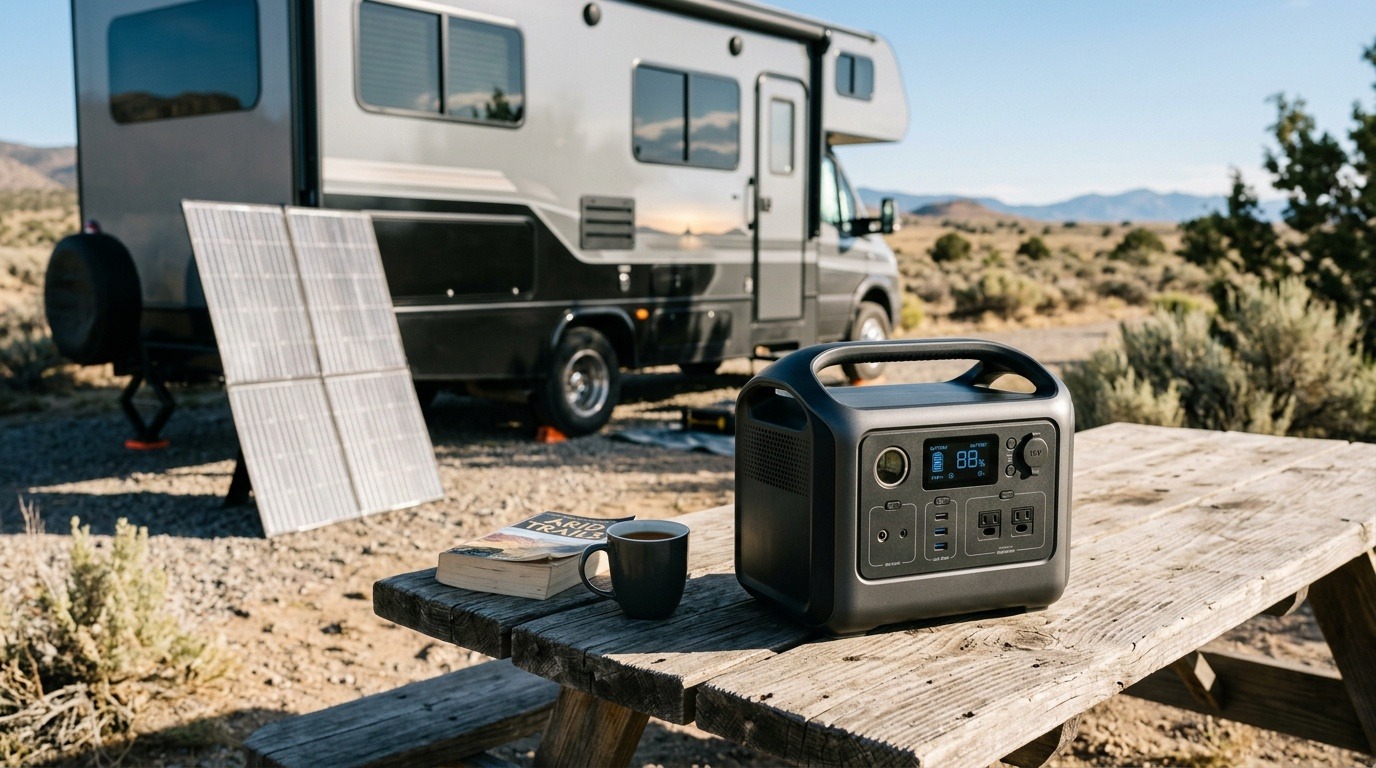
Our top pick: Anker Solix C1000 Gen 2 Solar Kit (Quick recharge kit)
Solar generator kits for RV use differ widely in capacity, output, recharge routes, weight and port layout, so the right pick depends on what you plan to run.
This roundup compares seven kits on the specifications their listings state, without claiming hands-on testing.
On this page
- Our Top Picks
- Anker Solix C1000 Gen 2 Solar Kit
- Bluetti Elite 200 V2 Kit with Dual Solar Panels
- Bluetti AC180 Solar Kit
- Anker Solix S2000 with 400W Solar Panel
- Jackery 1000 v2 Solar Kit
- EcoFlow Delta 3 Classic Solar Kit
- EcoFlow Delta 3 Max Solar Kit
- Start with your loads
- Compare recharge routes
- Weigh portability against capacity
- Read backup claims carefully
- Frequently Asked Questions
- Category verdict
More Details on Our Top Picks
Browse top pick on eBay: Anker Solix C1000 Gen 2 Solar Kit
Anker Solix C1000 Gen 2 Solar Kit
The 49-minute figure applies at 1,600W once HyperFlash is enabled in the Anker app.
The kit includes a PS200 Bifacial Portable Solar Panel.
The station and the solar panel arrive in two separate packages.
Bluetti Elite 200 V2 Kit with Dual Solar Panels
The kit pairs the power station with two 200W panels that ship separately.
The listing describes standby consumption of 10W.
The listed 2.4-hour solar full charge assumes 1000W of panels rather than the 400W in the kit.
Bluetti AC180 Solar Kit
A single cable at a maximum of 1440W is listed as a full charge in 1 hour.
The 200W solar panel ships separately.
Anker Solix S2000 with 400W Solar Panel
The listing states 10,000 charge cycles from 314Ah LFP cells.
The 35-hour fridge figure is tied to a 6W idle power draw.
There is no 12V DC port among its 8 outlets.
The power station and the 400W solar panel are dispatched separately.
Jackery 1000 v2 Solar Kit
The kit includes a 200W solar panel and 5 Years of Coverage.
The listing mentions a 600W Alternator Charger route for a full charge in 3 hours.
The one-hour charge needs emergency charging enabled in the Jackery App, and the default is 1.7 hours.
The listing says the generator and the 200W solar panel ship separately.
EcoFlow Delta 3 Classic Solar Kit
The listing states switchover to battery in under 10ms for PCs and servers.
The 220W bifacial panel uses N-Type solar cells with a conversion rate of up to 25%.
The station and the 220W panel arrive separately.
EcoFlow Delta 3 Max Solar Kit
X-Boost mode is described as running fridges, microwaves and power tools.
The listing describes a lighter, durable build with a LiFePO4 battery.
The EcoFlow app is described as monitoring energy use and managing charging and discharging schedules.
The 3400W figure applies to X-Boost mode specifically.
Browse top pick on eBay: Anker Solix C1000 Gen 2 Solar Kit
Frequently Asked Questions
What is the best solar powered generator for an RV?
The best choice depends on your appliances, your trip length and how much weight you can carry.
For a travel-focused pick, the Jackery kit lists a weight of 23.8 lbs with a foldable handle.
What size solar generator do I need to run a camper?
Add up the wattage of everything you want to run at once to find the output you need.
Then estimate daily energy use in watt-hours to choose a battery capacity with some margin.
Can I run my RV air conditioner on solar power?
It depends on the air conditioner's startup surge and running draw compared with the station's output power and the energy stored in its battery.
Check the air conditioner's specifications before relying on any station for it.
What is better for an RV, a generator or an inverter?
A solar generator combines a battery with an inverter, so it runs without fuel but is limited by its stored energy and recharge sources.
A fuel generator can run for longer when fuel is on hand, but it adds noise and fuel handling.
Category verdict
The Bluetti Elite 200 V2 kit suits buyers who want 2600W of continuous AC power and over 6,000 cycles.
The EcoFlow Delta 3 Max lists up to 3400W in X-Boost mode alongside 2048Wh of capacity.
The Anker Solix S2000 lists 35.7 lbs for a 2kWh-class station.
The Jackery 1000 v2 kit suits travelers who want a 23.8 lbs unit with a foldable handle.